Gravitational Waves Explained in Simple Terms

Ever wonder how scientists can learn about things that may be billions of light-years away if they can’t see those things in real time? The universe abounds with large masses, strong collisions, and extreme conditions that pose a challenge to normal telescopes. Gravitational waves are one of the most intriguing tools that scientists have today.
If the term sounds daunting, you don’t need to worry. It’s not as difficult as it seems. The basic idea doesn’t require any high-level mathematics. Gravitational waves are simply small ripples in space and time, at their most basic. They are formed by some of the most violent activities in the universe, such as the merging of black holes and the merging of neutron stars.
However, how does a gravitational wave work exactly? We have to get some idea of what spacetime is, what massive objects are, what cosmic collisions are, and what incredibly sensitive instruments scientists use to detect these signals.

What Are Gravitational Waves?
Gravitational waves are waves of the spacetime fabric. This concept is based on Albert Einstein’s general theory of relativity, which explored gravity as not only a pulling force but also how mass and energy affect spacetime.
An intuitive picture of spacetime is gained by imagining a stretchable surface. When a heavy object is placed on that surface, it is distorted. Changing disturbances in the system can be generated by moving objects. This comparison, however, doesn’t go quite so far. Space isn’t a piece of cloth or a sheet, and gravitational waves aren’t waves that pass through a material.
Rather, gravitational waves are changes in the geometry of spacetime itself. If two massive objects experience some sort of fast movement, the resulting change can radiate outwards in the form of a gravitational wave if it is large enough.
Gravitational waves are important, in part, for this reason. They provide data to scientists regarding the phenomena of the universe in a way different from the direct observations of typical optical astronomy.
How Do Gravitational Waves Work?
So, what is a gravitational wave in simple terms? It is akin to a chain: large objects move at very high speeds, the gravitational field generated by the changing mass can cause spacetime to be disturbed, the disturbance in spacetime then radiates outwards, and finally, a fragment of the disturbance can be seen here on Earth.
A gravitational wave is released by every moving object, but not all of these waves are detectable by scientists. The strength of everyday movements is too low. Even simple astronomical systems can emit signals that are too weak to be captured by existing instruments. Typically, detectable gravitational waves are generated from very energetic systems, such as the merging of massive compact objects.
An example of this is black holes. Suppose that two black holes orbit each other. The system can lose energy through gravitational radiation as they go through their orbit. Their orbit will slowly change, and they can spiral towards each other. Finally, when the two get close to combining, the gravitational wave gets stronger and changes faster.
This creates a wave that propagates through spacetime. When it arrives at Earth, its impact is extremely faint, though.
Scientists are looking to measure that little signal.
What Causes Gravitational Waves?
There are many possible sources of gravitational waves in the universe, most notably collisions and mergers of compact objects.
A binary black-hole merger is one important source. Systems involving two merging black holes can generate a powerful gravitational-wave signal as the two black holes orbit around one another and merge.
The other important source is the merging of two neutron stars. A neutron star is one of the densest objects in the universe, the end result of a very massive star. If two of them orbit each other and then collide, they can produce gravitational waves, as well as other radiation that is observable.
There can also be mergers between a black hole and a neutron star. Other potential sources of interest to scientists are continuous gravitational waves, which may originate from asymmetric rotating neutron stars.
Gravitational-wave patterns can come in different varieties. Those patterns can be used to learn about the objects involved, their masses, how they move, and what process created the signal.
It renders gravitational waves more than just a cool physics idea. They are information carriers of some of the harshest environments in the universe.
How Do Black Holes Merge, Producing Gravitational Waves?
One of the most well-known examples of gravitational waves is black-hole mergers.
Begin with two black holes in orbit around each other. They exchange energy in their orbits, and as they interact, they release gravitational radiation and lose energy in their orbits. The black holes slowly start to merge and increase their orbital frequency.
The signal of the gravitational waves is more pronounced as the merger nears. The typical high-frequency signal is called a “chirp” by scientists. So, finally, two black holes fuse to form a super black hole.
Once the two black holes merge, the new black hole becomes stable. The signal can be broken down into stages: inspiral, merger, and ringdown.
This process is especially useful since scientists can compare the gravitational-wave signal with the predictions of general relativity. The match-up of theory and observation is an important test of our understanding of gravity provided by this agreement.
GW150914 was the first gravitational-wave signal detected directly, and it was emitted when two black holes merged. That discovery gave the first direct evidence for gravitational waves and started a new chapter of gravitational-wave astronomy.
How Do Gravitational Waves Travel?
After being formed, gravitational waves travel away from the source through spacetime. According to general relativity, gravitational waves travel at the speed of light in a vacuum.
This means that the wave can travel a very long distance before reaching Earth after being created by a distant cosmic source. The signal could have been traveling for millions or even billions of years until it is picked up by scientists.
The strength of a wave decreases as it spreads outwards. This is why it is difficult to detect gravitational waves. A very powerful event can happen anywhere in the universe, but the disturbance felt on Earth can be very small.
Another aspect of particular importance is that gravitational waves have only a very weak interaction with matter. They can thus pass through vast distances without interference, unlike some electromagnetic signals that can be absorbed or dispersed.
Gravitational waves, in effect, enable scientists to “hear” information from locations and events that may not be able to be investigated by light.
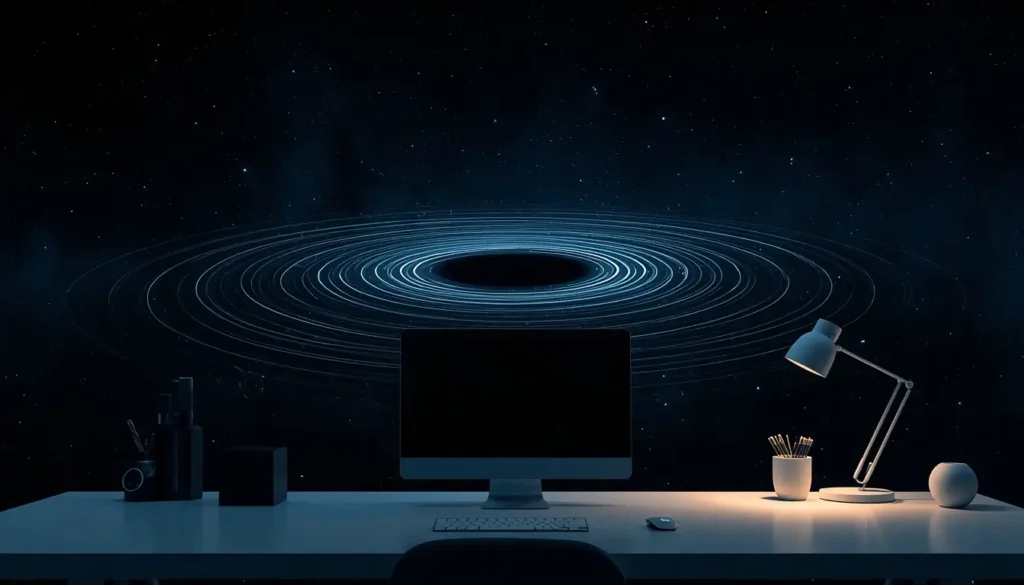
How Are Gravitational Waves Detected?
Special, very sensitive detectors are needed to detect gravitational waves. Consider one of the more popular observatories built for that purpose, the Laser Interferometer Gravitational-Wave Observatory (LIGO).
LIGO is based on the principle of laser interferometry, which is used to measure very small changes in distance. The detectors have two long arms at right angles to each other. Along these arms, laser beams travel, reflect on mirrors, and go back to make a comparison.
The laser system is normally designed to create a well-controlled interference pattern. A gravitational wave passing through a detector will squeeze and stretch spacetime in a back-and-forth manner. This makes the relative lengths of the detector’s arms change by a very small amount.
This interference pattern of the laser light changes as a result.
That change can be used to see if a gravitational-wave signal has passed through the detector. Scientists can then compare what they see in the signal with models to determine the likely source of the signal.
This is a truly amazing engineering feat, as the changes being measured are extremely minute. The detector has to isolate a real cosmic signal from vibrations, environmental noise, and the myriad of other noise sources on Earth.
Why Are Gravitational Waves Hard to Detect?
The most difficult thing is just the size of the signal.
The change in distance seen by a gravitational wave coming to Earth from a far-off event can be extremely small by the time it arrives. To achieve the sensitivity required to detect the signals emitted by colliding black holes, LIGO and other such observatories must be very sensitive.
The detectors also have to cope with noise. The Earth keeps moving! Measurements can be disturbed by traffic, Earth vibrations, machines, acoustic disturbances, thermal effects, and vibrations.
Now try to hear a very soft sound while standing beside a noisy street. It would take very complicated equipment and highly selective filters to get the sound you want out of the other sounds around you.
The challenge for gravitational-wave scientists is similar, but the measurements are much more precise.
That’s why it’s not just about constructing a long tunnel and switching on the laser when a gravitational wave passes through it. Carefully controlled instruments, isolation systems, data analysis, and theory are used by scientists and engineers to uncover real signals.
Gravitational Waves vs. Gravity: What’s the Difference?
While gravity and gravitational waves share common characteristics because they are both related to each other, they are not identical.
Gravity is the manifestation of mass and energy and, according to general relativity, is related to the geometry of spacetime. It describes phenomena like objects falling and orbital motion.
Gravitational waves, however, are the propagation of disturbances in spacetime. They are created by some dynamic systems, and they propagate outwards from their sources.
A cue to remember the difference is that gravity refers to the gravitational structure and effects that are associated with mass-energy, while gravitational waves are traveling changes in the geometry of spacetime.
This is significant because a gravitational-wave detector is not just detecting the normal gravitational attraction of a nearby object. It is measuring a very small, fluctuating strain due to an approaching wave.
What Does the Passage of a Gravitational Wave Through the Earth Do?
If a gravitational wave comes along, it doesn’t shake the Earth dramatically, and there’s no visible change.
Instead, it gives rise to a very small periodic expansion and contraction. Distances in one direction can get a tad longer, distances in another direction a tad shorter, and vice versa as the wave passes.
The impact is too small to be directly felt by people.
LIGO was built with the ability to detect these minute changes. It has great sensitivity and can detect changes that cannot be sensed by humans.
Gravitational waves would not, therefore, cause a sudden stretching or contracting of the Earth as a whole if they passed through. The key event is taking place at a level where it is necessary to use very specialized scientific instruments to see it.
Why Are Gravitational Waves Important?
Gravitational waves have revolutionized the way scientists explore the universe.
Electromagnetic radiation—visible light, radio waves, X-rays, and gamma rays—is often used in traditional astronomy. Events in the cosmos can also be seen in the gravitational-wave spectrum.
This is particularly beneficial for the study of black holes. However, black holes themselves do not emit the kind of light that stars do, so gravitational waves can help give us information about mergers involving black holes.
Neutron stars are another object that can be studied with gravitational waves, as can the predictions of general relativity and extreme environments that are hard to create or observe using other techniques.
Gravitational waves have provided a new window on the universe, most of all. Astronomical events can disrupt spacetime, and spacetime can be disturbed to reveal the physical processes occurring within them, beyond just observing what they emit as light.
As more and more gravitational-wave events are detected, and the observatories become more sensitive, the field is evolving.
Conclusion
The first step towards understanding what gravitational waves are is to embrace just one simple concept: a massive and highly energetic cosmic system can produce a disturbance in spacetime that spreads outward as a gravitational wave.
These waves can be produced by extremely violent interactions of black holes or neutron stars and can travel vast distances before reaching Earth. The effect of those waves is unbelievably small by the time they reach here. However, such changes can be detected with instruments like LIGO, which employs laser interferometry.
Gravitational waves are significant because they provide scientists with a new force to explore the universe. They can provide clues to black-hole mergers, neutron stars, cosmic events, and the nature of gravity.
It is not essential to have advanced mathematics and expensive equipment to start learning about this. When it comes to education and learning, a little bit of curiosity and clear explanation goes a long way. In some cases, it is merely a matter of breaking down a complex idea into smaller parts.
Frequently Asked Questions
In Simple Terms, What Is a Gravitational Wave?
Gravitational waves are ripples in spacetime generated by some energetic, accelerating cosmic systems and are extremely small in scale.
How Do Gravitational Waves Work?
Extreme motion in massive cosmic systems causes disturbances that change in space and time and travel outwards as gravitational waves, which eventually can be recorded by sensitive instruments.
How Are Gravitational Waves Caused?
They are expected to come from several sources, such as merging black holes, merging neutron stars, black-hole/neutron-star mergers, and perhaps other astronomically energetic or highly asymmetric systems.
How Is It That LIGO Can Detect Gravitational Waves?
Gravitational waves pass through LIGO, triggering changes in the relative lengths of the perpendicular detector arms as they pass, which are measured by laser interferometers.
Will Humans Be Able to Sense Gravitational Waves?
No. Gravitational waves can pass through the Earth, but the effect on Earth is too small to detect directly. They can only be measured using specialized detectors.