Do Scientists Agree on Dark Energy? Infinite Unknowns

Anyone who has ever looked up at the night sky and asked “what’s keeping our universe apart” or “what’s holding it up” is asking one of the greatest unanswered questions in contemporary physics. Scientists have a term for this enigmatic power: dark energy. However, naming is not the same as understanding and, at this moment, some of the world’s foremost cosmologists are doubting concepts that they have been working on for years.
This is a wonderfully readable overview of the state of science, offering an honest and open perspective on what the experts actually agree on – and what they don’t.

What is Dark Energy?
The nature of dark energy is the big mystery in cosmology: it is what is driving the universe’s expansion. Throughout the first half of the 20th century, astronomers believed that gravity would eventually halt the expansion of the universe that started with the Big Bang, as a ball thrown into the air will eventually stop and fall back to Earth. Rather, observations in the late 1990s found that the universe is actually speeding up in its expansion.
That acceleration doesn’t act like any type of matter or energy that we know of. It does not form into a clump like galaxies or dust do. It does not affect the light as we are able to see it. But, from the way galaxies move and how the universe’s geometry seems to behave, scientists estimate that dark energy accounts for approximately 68 percent of all that is. The regular matter, which makes up stars, planets and humans, represents only about 5 percent.
But the simplest explanation is that gravity brings things together, dark energy drives things apart — and that’s what it is doing now.
Clearing Up the Confusion Between Dark Energy and Dark Matter
Dark energy and dark matter are not the same phenomenon, and that’s why they’re often confused with each other.
Dark matter is believed to be an invisible mass of matter that provides additional gravitational attraction, which accounts for the rotation of galaxies and the fact that they are bound together so tightly. It functions like a glue, a glue that acts under gravity.
However, dark energy has the opposite function. It doesn’t “grab things together”—its relationship is to the increasing extension of space. Dark matter is a mysterious hand that guides the formation of galaxies, while dark energy is a mysterious pressure that pulls galaxies apart. They’re both not detected directly, they’re both deduced by their effects, but they’re opposites in the universe.
The Cosmological Constant and the Standard Model
The primary theory that has been in play for dark energy over the past 25 years was a theory known as Lambda, or the cosmological constant. The concept is a beautiful one—dark energy is a universal and constant characteristic of space. The more this constant energy is manifested, the greater the space and the greater the acceleration of the expansion.
The idea lies at the backbone of cosmology’s contemporary paradigm, referred to as the Lambda-CDM model, which is a theory about the universe that relies on CDM, or cold dark matter. This model has been very successful for decades in accounting for the observations of astronomers, from the afterglow left by the Big Bang to the large-scale structure of galaxies. It has been the conventional and generally accepted theory, easily testable and in line with a vast body of data.
This doesn’t mean “unquestioned,” though, and that is where things get interesting.
The New Developments in DESI’s Research
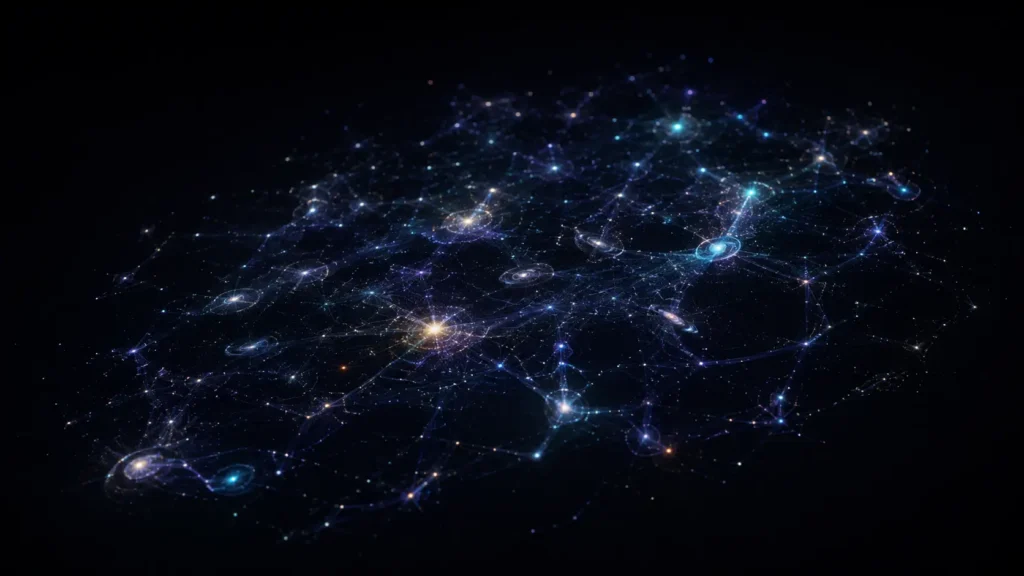
Much of the current excitement can be traced to an international effort led by the U.S. Department of Energy’s Lawrence Berkeley National Laboratory that involves hundreds of researchers across dozens of institutions, known as the Dark Energy Spectroscopic Instrument (DESI). The task that DESI faces is massive: to create the largest three-dimensional map of the universe ever made, to catalogue tens of millions of galaxies and quasars to track the evolution of the cosmic structure over billions of years.
The first few years of DESI’s data, when combined with other cosmological measurements, yielded an unexpected result. Rather than confirming the fixed and constant prediction of a cosmological constant, the data from both experiments suggest that dark energy could be changing strength as the Universe ages. Taken entirely on its own, DESI’s data is still consistent with the standard model. When combined with other measurements, the pattern has been called one of the best indications yet that dark energy might not be as constant as previously thought.
That distinction is of huge importance. A dark energy that changes over time would mean the simple, elegant cosmological constant isn’t the whole story — and that physicists may need entirely new theoretical models to explain what’s really going on.
Where Experts Agree — And Where They Don’t
There is a lot of excitement in the cosmology community, but there is a lot of caution in the cosmology community as well, and that’s something that’s worth sitting on rather than smoothing over.
From one perspective, those who are directly involved in DESI have said the results are “fascinating,” and in some ways, the field could be in the midst of a paradigm change in how to model the universe. Such language is not used lightly among scientists who have been trained to be skeptical of their own data.
In other quarters, however, there are many experts who say to wait. Some scientists argue that this signal could be caused by miniscule systematic errors, especially in the way supernova brightness is measured, even if dark energy doesn’t vary at all. To determine if it’s a true cosmological change or some sort of measurement error, much more data is needed — and very precise techniques.
It is not a fault in science when such a disagreement occurs. It is a testament to science’s success. Extraordinary claims must be supported by extraordinary evidence and a changing dark energy would be extraordinary, so it’s time for extraordinary evidence — and while current evidence is strong, it is not yet conclusive.
How to Distinguish Between the Science That Is Known and the Science That Is Still Unknown
It helps to distinguish what is well established from what is still a topic of debate.
Well established: The expansion theory of the universe is indeed correct. This has been verified many times using separate pieces of evidence, such as distant supernovae, cosmic microwave background, and large-scale galaxy surveys such as DESI. So that’s not really in question.
Still open to debate: What exactly is driving that acceleration remains an open question. Dark energy is simply a catch-all term for an observed phenomenon whose origin is still not known. It may be a real cosmological constant! It could be a changing field. It could even be a clue about the lack of understanding of gravity on the largest scales. Scientists don’t just have to fill in details at this stage, they still need to figure out which general class of explanation is the right one.
The gap is between the fact of there being an accelerating expansion and the possible nature of dark energy, and it’s that difference that makes headlines about dark energy sound dramatic while the science itself is careful and incremental.
The Expansion of the Universe and Its Fate
Dark energy isn’t just a scientific curiosity — it has real implications for the end of the universe’s story. If dark energy is indeed constant, the universe would continue to expand and cool forever, resembling a heat death, when stars turn off and the universe will eventually become cold, dark and still, out to great distances.
The future picture is much more complicated, however, if dark energy is changing. Some theoretical models even suggest that it could slow down, undergo a ‘Big Rip’ scenario, or something else which physicists haven’t even thought of yet. Of course no one is directly affected by this, as these are time scales of billions of years. However, it does change the way that physicists view the fundamental rules of all things, from the smallest of particles to the biggest of structures.But DESI’s work is not yet over. The survey has already yielded cosmological information on tens of millions of galaxies and quasars, well beyond its original scope, and is steadily building up its catalogue of the sky. Its full, multi-year data set will yield its first results in the coming year, with the expectation that it will either reinforce the idea of dark energy evolving or resolve the discrepancies with the constant-energy model.
Conclusion
One of the biggest unsolved physics riddles is dark energy, a mysterious force that we are able to detect but cannot yet fully comprehend. The consensus is that there is an acceleration in the expansion of the universe — and that’s settled. The question that remains to be debated is why and whether the 25-year-old explanation should be reconsidered.
Science isn’t weak if it is uncertain. It’s the process that’s going just as it’s supposed to go: careful researchers sifting through the extraordinary possibilities for the ordinary explanations that came before. As more data comes in over the next several years, we could soon have an answer to one of the biggest questions about the Universe in which we live. For now it’s an incredibly interesting period for watching.
Frequently Asked Questions
Does dark energy really exist?
The observations supporting the accelerating expansion of the universe that dark energy is supposed to account for have been independently confirmed many times. However, the cause is not directly detected, but rather inferred.
What’s the difference between dark energy and dark matter?
Dark energy is related to the force that drives space apart, while dark matter provides additional gravitational force that helps to keep galaxies locked together—the two exert opposite effects.
Are there really scientists that don’t agree on what dark energy is?
Yes. There are some researchers who prefer to believe that the cosmological constant is a constant, and others who see evidence that the power of dark energy could vary over time. The discussion is ongoing and debatable.
Why is DESI important and what does it mean?
The Dark Energy Spectroscopic Instrument (DESI) is a large international survey that will map millions of galaxies in three dimensions to investigate how the universe has evolved over billions of years. Its latest results are key to the ongoing debate about the constancy of dark energy.
When will scientists have more answers?
The team hopes to get further results from DESI’s complete data set in the near future, which will aid in testing or disproving the notion that dark energy is changing over time.