Learn Brain-Computer Interfaces Step by Step


The concept of someone controlling a computer, robotic arm, or even a cursor on a screen with just their thoughts had long been the stuff of science fiction. That idea is now a growing reality of science and medicine, with brain-computer interface (BCI) technology enabling people to interact with a device without using their hands, feet, keyboard, or mouse.
This is an easy-to-follow, step-by-step introduction to brain-computer interfaces, how they currently work, and what they mean for medicine, accessibility, and technology more broadly.
What Is a Brain-Computer Interface?
A brain-computer interface (BCI) is a system that allows the brain to communicate with an external device without relying on the body’s muscles or nervous system. A BCI isn’t something you type on or physically press a button for — instead, it reads the electrical signals fired by the brain and translates them into instructions that a computer or machine can interpret and act on.
This technology was initially developed for medical use, particularly for individuals experiencing severe paralysis or neurological disorders, to help them communicate or control their surroundings. In recent years, the field has developed significantly, expanding well beyond its original, primarily medical purpose.
Step One: The Brain Generates the Signals a BCI Reads
To understand how a BCI works, it helps to understand a basic truth about the brain itself: every action it undertakes — whether thinking, moving, or sensing — is fundamentally electrical. The brain is made up of nerve cells called neurons, which pass information to one another through small electrical currents. When a group of neurons activates in unison, it produces a measurable pattern of electrical activity.
These patterns of neural activity tend to differ depending on whether someone is imagining a movement, focusing attention on a specific action, or processing a particular thought. This is the core principle a BCI relies on: reading these patterns, learning to recognize them, and correlating them with an intended action.
Step Two: How BCIs Measure Brain Activity
Techniques for detecting brain activity broadly fall into two categories: non-invasive and invasive.
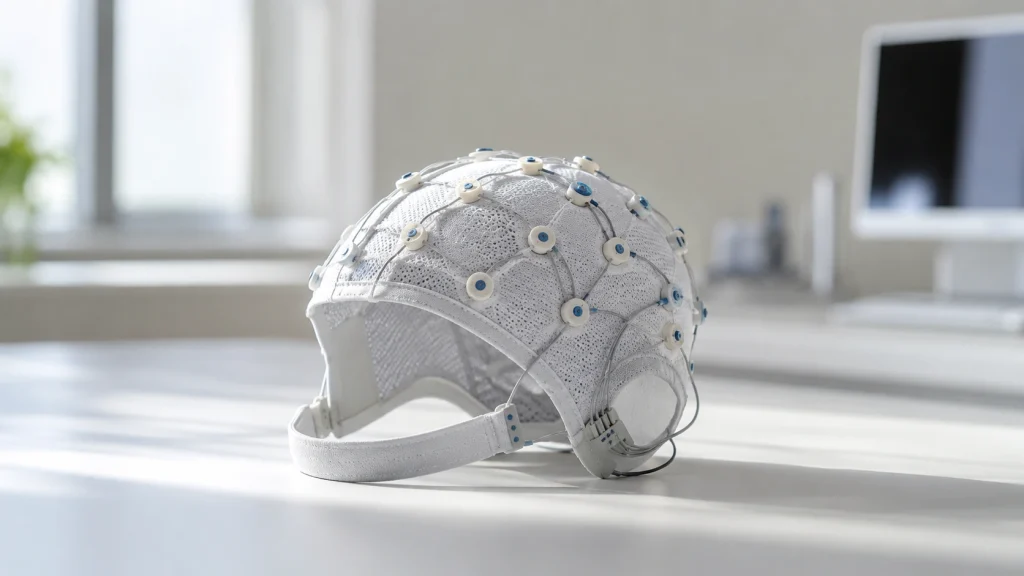
The most common approach for non-invasive BCIs is electroencephalography (EEG), which uses sensors placed on the scalp to detect electrical activity from outside the skull. This method doesn’t require surgery, making it much safer and more widely accessible, but it’s also less precise, since the electrical activity reaching the sensors is naturally distorted and blurred by the skull and scalp.
Invasive BCIs, by contrast, require surgically inserting electrodes into or onto brain tissue itself. This approach can capture much more accurate and detailed signals directly from single neurons or small groups of neurons, offering far higher resolution. However, it involves an actual surgical procedure, with real perioperative risks and complexity not present with non-invasive methods — which is why invasive BCIs are mainly reserved for patients with serious conditions that can’t otherwise be treated.
Step Three: Converting Raw Brain Signals Into Commands
Detecting brain activity is only half the battle. Whether signals come from EEG sensors or implanted electrodes, they’re essentially noise until properly translated — this is where signal processing and machine learning come in.
Specialized software decodes the detected brain signals, filters out background noise, and identifies the pattern associated with a person’s intended action. As users train with these systems — practicing mental commands to move a cursor, select a letter on a screen, or control a robotic arm — the systems become increasingly accurate at determining what the person intends to do.
Step Four: Converting Commands Into Action
Once a brain signal has been correctly interpreted, the system must convert that command into a physical or digital action. This final step can take different forms depending on the application.
It might involve selecting letters or words on a screen to enable communication for people who can’t speak or type through conventional means. In motor-related applications, it could mean controlling a robotic arm or wheelchair, or, in certain advanced research settings, sending signals aimed at restoring some natural limb movement for people with paralysis.
The Most Advanced Application of BCI Today
While BCIs are often discussed in more futuristic or consumer-oriented contexts, the vast majority of existing, real-world applications remain in medicine — particularly for patients with severe motor impairments.
For people with conditions such as ALS, spinal cord injury, or severe paralysis following a stroke, BCIs can offer a meaningful way to communicate or interact with the world when moving their body is no longer possible. Researchers are also exploring the use of BCIs to help restore some lost movement or sensation, though this area is considerably more complex and less developed than communication-based applications.
Beyond communication and movement, scientists are also investigating BCIs for mood and seizure monitoring. If neural patterns associated with mood changes or seizures can be reliably detected, a BCI could potentially help predict — or even help manage — certain neurological or psychiatric conditions before they become critical. While still far less developed than communication-based BCIs, this is an important and growing area where the technology could eventually extend beyond motor control.
What Makes BCI Technology So Difficult?
Despite real progress, significant technical and practical hurdles remain in BCI development. Electrical activity in the brain is inherently complex and unique to each individual, meaning systems often require extensive calibration and training to work effectively for a given user.
Non-invasive methods, while safer, are less precise and less clear. Invasive methods offer greater precision but carry genuine surgical risks, along with unresolved long-term questions about how implanted devices interact with brain tissue over extended periods. On top of that, translating detected brain activity into smooth, natural, and reliable device control remains a genuinely difficult engineering and computational challenge — one that has been improving steadily, but gradually, rather than through dramatic breakthroughs.
Common Misconceptions About Brain-Computer Interfaces
Several misconceptions persist about BCI technology, most of which significantly overestimate where the field currently stands.
A popular misconception is that BCIs can read complex thoughts, memories, or detailed mental content. In reality, current BCI technology measures relatively simple, specific patterns of neural activity tied to an intended action — not the actual content of a person’s thoughts or complex internal experiences. Another common misunderstanding is that BCI technology is primarily aimed at everyday consumers, such as people wanting to play video games or control smartphones with their thoughts. While some research does explore these directions, most existing, practical BCI applications remain focused on medical use for individuals with significant physical impairments. There’s also a widespread assumption that BCIs always require invasive brain surgery. In reality, non-invasive EEG-based systems represent an important and actively evolving part of the field, particularly in cases where extremely high signal precision isn’t required.
Where BCI Technology Is Headed Next
Several trends are likely to continue shaping BCI development going forward. Advances in signal processing and machine learning will likely continue, allowing systems to analyze brain activity more efficiently with less calibration and training required. Hardware improvements — such as smaller, more comfortable non-invasive sensors and safer, longer-lasting implantable devices — are also expected to expand the range of possible BCI applications.
As research progresses, BCI applications will likely gradually extend beyond their current, largely medical focus — though mainstream consumer applications remain a much more distant prospect than some popular claims about the technology might suggest.
Collaboration between neuroscience researchers, engineers, and clinicians will likely remain essential to BCI development, since meaningful advances typically require expertise spanning several distinct disciplines. This interdisciplinary nature is a key reason BCI development tends to progress incrementally, through careful, well-tested research, rather than through the sudden, sensational breakthroughs sometimes claimed in other areas of technology.

Final Thoughts
Brain-computer interfaces represent a genuinely remarkable fusion of neuroscience, computer science, and engineering, allowing the brain’s electrical signals to directly control external devices. From detecting neural signals, to interpreting them through sophisticated software, to triggering real-world action, this technology has already made meaningful improvements to the lives of individuals living with severe physical disabilities.
While significant hurdles remain, and public discussion of the technology is sometimes exaggerated, BCI research continues to progress steadily — pointing toward a promising, if not yet fully realized, future for human-technology interaction based on thought alone.
Frequently Asked Questions
In simple terms, what is a brain-computer interface?
A brain-computer interface is a system that detects electrical signals produced by the brain and translates them into instructions for a computer or other device, allowing a person to control it without physically moving their body.
What’s the difference between invasive and non-invasive BCIs?
Non-invasive BCIs use sensors placed on the surface of the scalp, while invasive BCIs involve electrodes implanted inside the body, usually through surgery. Invasive systems provide more precise signals but carry greater surgical risk.
Can current BCI technology capture complex thoughts or memories?
No. Current BCIs mainly detect relatively simple, specific neural patterns tied to intended actions — not detailed thought content or complex internal experiences.
Who benefits most from BCI technology today?
Most existing, practical BCI systems are designed for individuals whose motor function has been seriously impaired by disease, injury, or paralysis — such as those with ALS or spinal cord injuries — to help them communicate or interact with their environment.
Does BCI technology have a future in consumer electronics?
Not in the near term. While some research explores broader consumer applications, most practical, real-world BCI use remains focused on medical applications, with wider consumer adoption likely still a considerable way off.